John Burt Sanders Explores Color and Abstraction in Art
By Shawn Simmons
April 15, 2026
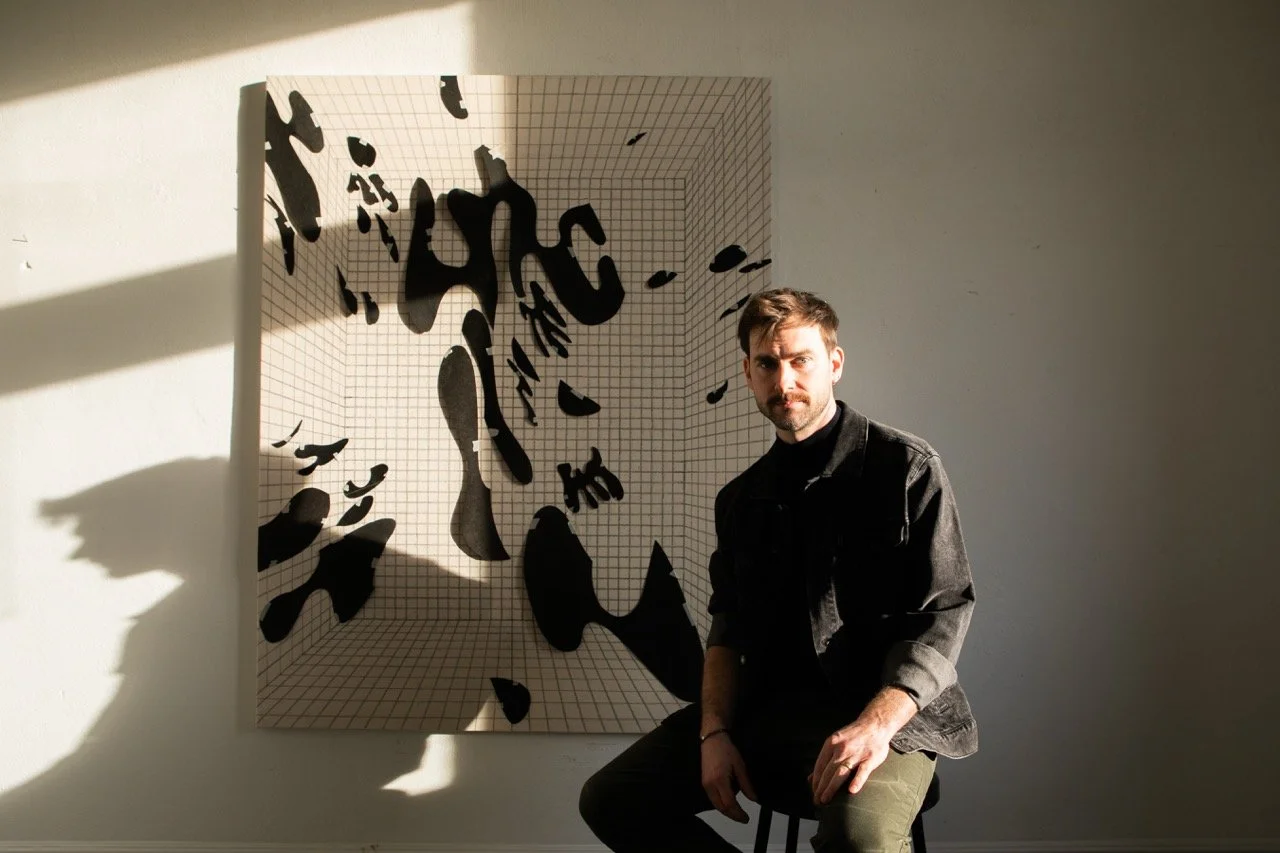
John Burt Sanders has spent more than a decade living and working in Wilkinsburg, but his paintings resist the idea of settling into a fixed visual language. They operate in a state of productive instability, insisting on looking as an active, physical process rather than a simple act of recognition. His paintings do not present images so much as they generate conditions: fields of color and texture that oscillate between subtle modulation and sensory overload, holding the viewer in a prolonged encounter that is felt in the body as much as in the mind.
Sanders grew up in Western New York and studied painting and art history at SUNY Fredonia before pursuing an MFA in painting and drawing at Ohio University. It was during that period, through friends and mentors, that he began spending time in Pittsburgh, drawn by the possibility of sustaining a life as an artist over the long term. Fourteen years later, that possibility has taken concrete form in a studio he has occupied for the past five years: a cavernous upper floor in a late-nineteenth-century building, its soaring ceilings and arched windows providing the scale and light his work requires.
Before it became his studio five years ago, Sanders had long admired the building from the outside. He gestures to a used flat file in the corner, recalling that when he went to pick it up, he realized the address matched the same vacant Wilkinsburg building he had passed for years. Soon after, the upper floor became his studio.
The paintings lining Sanders’s walls mark a noticeable shift from earlier work. He describes them as “unformed,” and the word feels precise. Inspired by the pastel excess of rococo painting—think Watteau or Fragonard—these new works combine that elegance with the glitchy violence of early video games. He notes that in the graphics of games like Mortal Kombat, blood splatters often resemble Rorschach inkblots, abstract forms loaded with projection. The result is a kind of visual embrace of excess and saturation.
Sanders connects these themes to growing up queer and playing video games, noting that he always spent extra time on character selection screens—spaces of fantasy where identities are tried on rather than resolved. For him, the appeal of gaming centers on multiplicity, with new characters continually opening new possibilities. “Abstraction is by its very nature indeterminant,” he says. “That’s why I come back to it.” In painting, as in queerness, formlessness becomes a site of freedom. It holds the capacity for competing impulses without forcing resolution.
That same logic shapes the making of the work. In Sanders’s practice, influences loop back, recur, mutate. Knowing when a painting is finished is intuitive, he explains, and he is careful not to overwork a surface: “Process should never be debilitating.” What matters, in the end, is keeping the work from ever fully settling.
Deep Field Narration
by Jessie Rommelt
September 6, 2023
In a time when new images of distant galaxy clusters are made by hyper-advanced infrared telescopes and roughly one billion users post videos and images multiple times a day to social media, critics and artists alike have found themselves asking: is painting dead? To skeptics, paintings are at best anthropologically-charged relics from a time long past, and at worst, paintings are the objects of desire, traded on a global market of untraceable aggregated wealth. John Burt Sanders‘ current exhibition of oil paintings, Spontaneous Horizon (2022) at here gallery, curated by owner/curator Lexi Bishop, takes this convoluted landscape into account while unapologetically stepping into a new chapter of artistic practice.
Artist John Burt Sanders (JBS) has called Pittsburgh home for more than 10 years. He relocated here after grad school looking for a city that would, most importantly, be affordable. Pittsburgh was the city where he could realistically support himself and devote considerable time to making paintings. JBS has most recently presented solo exhibitions at UnSmoked Systems in Braddock as well as Bar Marco. He has become known for his signature interlacing forms and his unique approach to contemporary abstract painting.
The other key voice in this exhibition is the owner/director of here gallery, Lexi Bishop. With a specialty in Contemporary and Post-War art from Christie’s Auction House she brings nearly a decade of art world experience to the table (her action-oriented approach and sharp humor also plays an important role in her business). Lexi moved to Pittsburgh from LA right before the pandemic to join her artist partner, Wade Kramm who had recently returned from NYC to his hometown of Oakmont (20 min North of Pittsburgh). From there Lexi set out on a journey to launch her own gallery in the city she now called home. She has been producing exhibitions in Pittsburgh for the last year and a half, some of which were presented at roaming locations, like The Boys Club and Arsenal Motors in Lawrenceville. After a winding search for the perfect gallery space, Bishop landed in the Mexican War streets on the Northside, just a short walk from the Mattress Factory Museum. Bishop is one of a small number of young gallerists in Pittsburgh who run commercial galleries and is fully invested in Pittsburgh as an up-and coming contemporary art city.
On June 30th, 2022, JBS and Lexi Bishop joined Bunker Projects’ Creative Director Jessie Rommelt for a conversation on Instagram Live. The trio discussed how Bishop and Sanders met and conceived of Spontaneous Horizon, as well as the collaborative relationship between artist and curator/gallery owner. JBS talked about the many influences of classical painting on his works, and Bishop teased out the show’s concerns with environmental degradation, urban decay and climate catastrophe. This feature is an outgrowth of this conversation, as well as a mediation on the exhibition as a whole.
The stories of these two individuals collide somewhere early in 2021 when John Burt Sanders visited Bishop’s first Pittsburgh-based exhibition, Deep Blue by Molly Greene. John was just there to enjoy the show but then the two got to talking. A studio visit led to an ongoing dialogue and Bishop brought a selection of Sanders’ work into an online sales catalog. This type of organic partnership between artist and gallerist is an important litmus test for any future partnership, as it shows whether gallerist and artist work can collaborate in a way that grows each of their respective practices. Thanks to their collaboration, JBS brings new techniques and attitudes to this show.
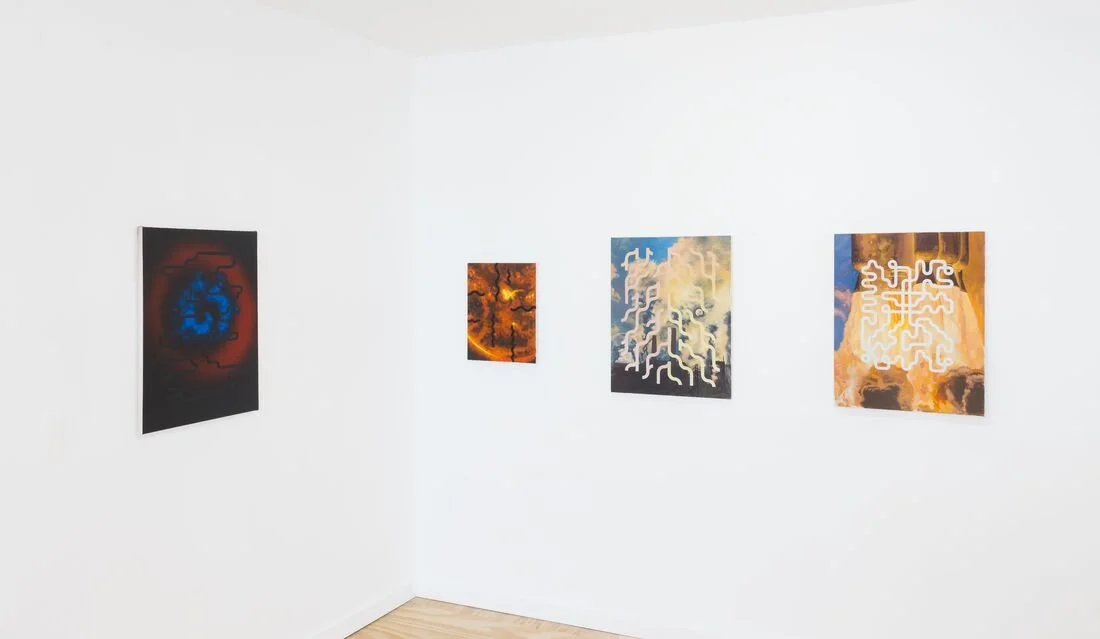
Spontaneous Horizon marks an epoch in Sanders’ work where iconic images and historical paintings (likely obscure to most non-art-history buffs) are used as layered visual material. By intentionally remastering archival paintings and photographs that span the 18th, 19th, 20th and 21st centuries, he builds various augmented realities on the surface of each painting that are married with his signature interlacing forms and brushwork. “It’s always a nice surprise to be able to combine imagery and see it result in something that feels new or fresh, or a combination that feels powerful in some way. I didn’t know if it was going to work until the last minute when I removed the masking and saw the combination of the line work over the image. So in that way, they feel risky to spend a lot of time on something that may not actually work,” Sanders remarks.
In his previous decade of work JBS explored a wide range of expressionist surfaces and tonal effects. An architectural approach to color is interrupted with glitches and line-breaks bringing in a sense of effortless spontaneity. The majority of his past work is void of pictorial tradition. In contrast, while the interlacing forms in Spontaneous Horizon are some of the most enduring languages in his work, they are being orchestrated very differently as they interact with the underlaid imagery and tight cropping, gesturing to the spirit of power-play and compromise. In this new series, JBS deliberately brings in moments and icons from the past and present — the atomic bomb, the iceberg, the galaxy, the forest. As Bishop puts it, “It feels like in this body of work, it’s about human excesses, but especially in relation to nature and its effects on the natural world.”
In this show, the interlacing forms take on a new agency that allows them to brand, pierce, dissolve, veil and restrain the imagery underneath. The loyalty JBS has to his interlacing forms is impressive especially because they are such a source of unease for the viewer; they keep the viewer away from settling into any comfortable conclusion. This phenomenon of feeling a strange, almost ticklish distance from being able to know something (anything) is what JBS does so well. He is interested in playing with our discomfort of the unknown and perhaps even the paralysis of feeling like there is no answer, no action.
One could reasonably argue that this exhibition deals with our ongoing moment of environmental reckoning; there are many expressions of the degradation of the natural world present in this series of paintings. Each painting takes us to a different location, some that feel very earthly, others cosmic or even theoretical. Perhaps the one closest to home is in Confluence (2022), where JBS renders his take on Darrell Sapp’s photograph for Pittsburgh Post Gazette of the 2018 Clairton Coke Plant fire. The piece is not only affective for natives of the Pittsburgh region but humankind in general, as we experience daily life subject to on-going air and water pollution whose ramifications are species-deep.
Perhaps one of the hardest things we can do is sit with the discomfort of not knowing how to contribute to change– the impotent feeling that that no matter what we do we are just a speck of dust in deep space. All of these affects are present in Spontaneous Horizon, but the show also presents a playful figment of hope. Each painting is ready and willing to be an ever changing game board for your state of mind, when you’re enjoying it or when you’re perplexed, pessimistic or tired. They are ready to unfold with you and be a container for your mental map, your tongue-tied conversation or imploding lucid dream.
THE ALIEN WORLD OF JOHN BURT SANDERS’ DARK MODE
by Emma Riva
August 15, 2024
Why is your phone so dark? If I had a dollar for every time I answered that, I would be rich. Or, anyone who’s ever tried to watch a movie on my laptop has gotten confused by the pervasive sepia tone reminiscent of the Mexico scenes in Breaking Bad. I have “dark mode” on essentially all the time to prevent eye strain from blue light. This might be a futile exercise. But “dark mode” is a very cool name for something. And John Burt Sanders’ Dark Mode at Zynka Gallery is anything but dark. I got to the show at 7 and at least a quarter of the paintings had been sold. Little red dots abound. Clearly, the work resonated, and I found myself wanting to spend more time with the paintings to feel them out further.
Sanders referred to “dark mode” itself as “a daily ritual of gradual psychic decomposition from technology and information consumption. Most people who use dark mode probably are aware that reducing points of blue light is not changing how addicted they are to the piece of metal in their hands. It’s a contradictory state.
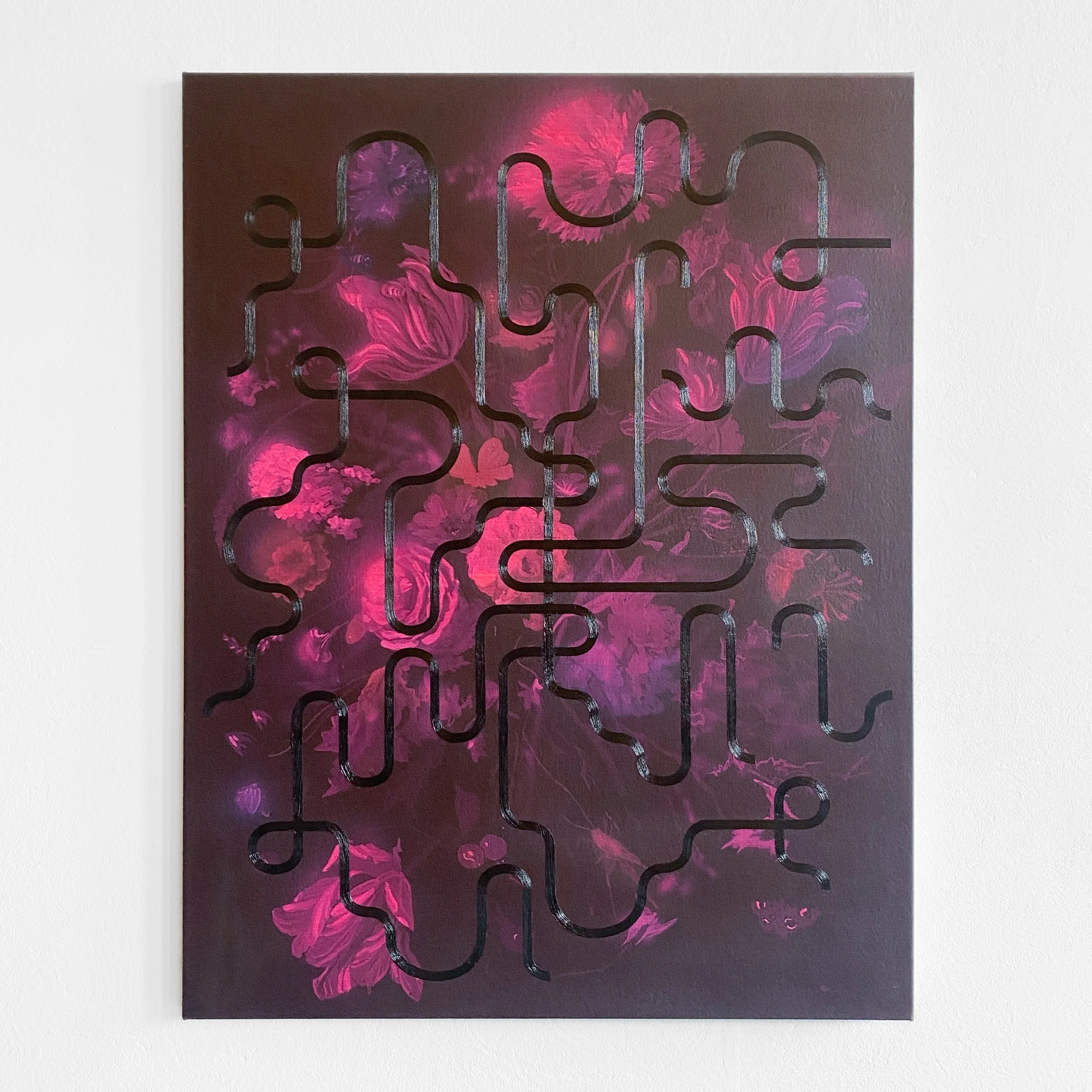
Sanders’ paintings live in that contrast. They straddle the line between frenetic and fluid. He manages to create a three-dimensional glow on a canvas with the combination of the soft anachronism still life and the gestural swirls of Sanders’ style. His paintings are about contrast. They feel both tactile and cold. There’s texture and also the untouchable. Later I realized the word that summed them up best: alien.
Battle Meditation shows tesseract-like shapes interacting with each other. The changes in weight of each brushstrokes give it a dynamic glow. Sanders shows just how much can be done with just acrylic—the paintings are remarkable technical achievements. He leans into the alien motif with imagery from the Hubble space telescope.
In the corner of Hi-techstacy, an indigo squiggle adds a tiny bit of surprise to the smoothness of the composition. There were times when as I photographed the paintings, my phone tried to scan them as QR codes. How are images now made to be decoded or scanned rather than experienced?
The show is a sensory delight, but at the same time, there is a sadness to it. We can see, with our own eyes, galaxies we could never reach, but now we know that there are worlds beyond what we can actually experience. That knowing is a lack. When you have access to the right answer to any question through a device in your hand, no wonder so many people feel always wrong. Dark Mode can be meta, it’s a show of beautiful achievements that also works as a meditation on existential emptiness.
Just a few paintings, Chaos Stream, Shadow Net, and Still Shift, remove the tessellation lines. One shape in it brings to mind the face of a pigeon or otherwise colorful bird. It’s a softened version of the sleek composition of everything else that reduces the image to its shape. Sanders frequently places moths in the still life images behind the tessellations, and the paintings bring to mind the eerie, nocturnal beauty of a moth. The show’s staging also lent to its success. Gallerist Jeff Jarzynka has a real eye for where to put works that need natural light in the spots that make them pop.
One of the things I found most compelling about the work was actually when I left the gallery. As I walked through Sharpsburg, I found I could see Sanders’ tessellations in the nature and manmade structures around me. Moss poking through cobblestones. Electric wires criss-crossing the gradient of the horizon. The crests of waves in the Allegheny River. Sanders’ work can be an invitation to get out of your head and look at the world without neurosis.
Ghosts of the Future: Behrens & Sanders
By Jeremy Bendik-Keymer
December 25, 2020
For philosophy, maybe the ghosts of the future come out of living in communities more than in academies. Given what a tough year this has been for many of us academics – with precarious job markets and uncertain futures – I’m wondering.
In early December, I saw a post about some of my partner’s old friends. John Burt Sanders, a painter, had a COVID-19-safe show inside a house that Joey Behrens has been restoring as part of her engagement with land and homes. They live in a Wilkinsburg, Pennsylvania neighborhood, John with his partner Haylee Ebersole and Joey with her husband,Tony Foster, an IT professional. Within a complex city, they’re working to become part of the place – like in Haylee’s print shop and programs for area youth.
These folks are not academically trained philosophers, but their lives are thoughtful. With them, I get a sense of how anything can be philosophical – even a desolate house. I wanted to know if Joey & John would tell the story of the house-show.
THE SOLUTION LINE
(Joey): John and I had been talking about his transition to a full time studio practice. It’s a shift that, in my experience, can be surprisingly challenging to make, let alone sustain. John said that he wished he had a show lined up somewhere, a deadline, something he had to produce for.
And I thought, Okay, I have a space...
The building, once a single family home, had undergone several remodels with an addition tacked on. These reconfigured it into three apartments, one per floor. My attention was currently focused on the first floor apartment. So I offered John the top two floors.
I don’t think John had been in the house since I had cleaned it out. He came over to check it out, spending a good hour or two with the space taking notes. [He was] excited about the way the light interacted with the wall colors and the way the rooms layer on each other.
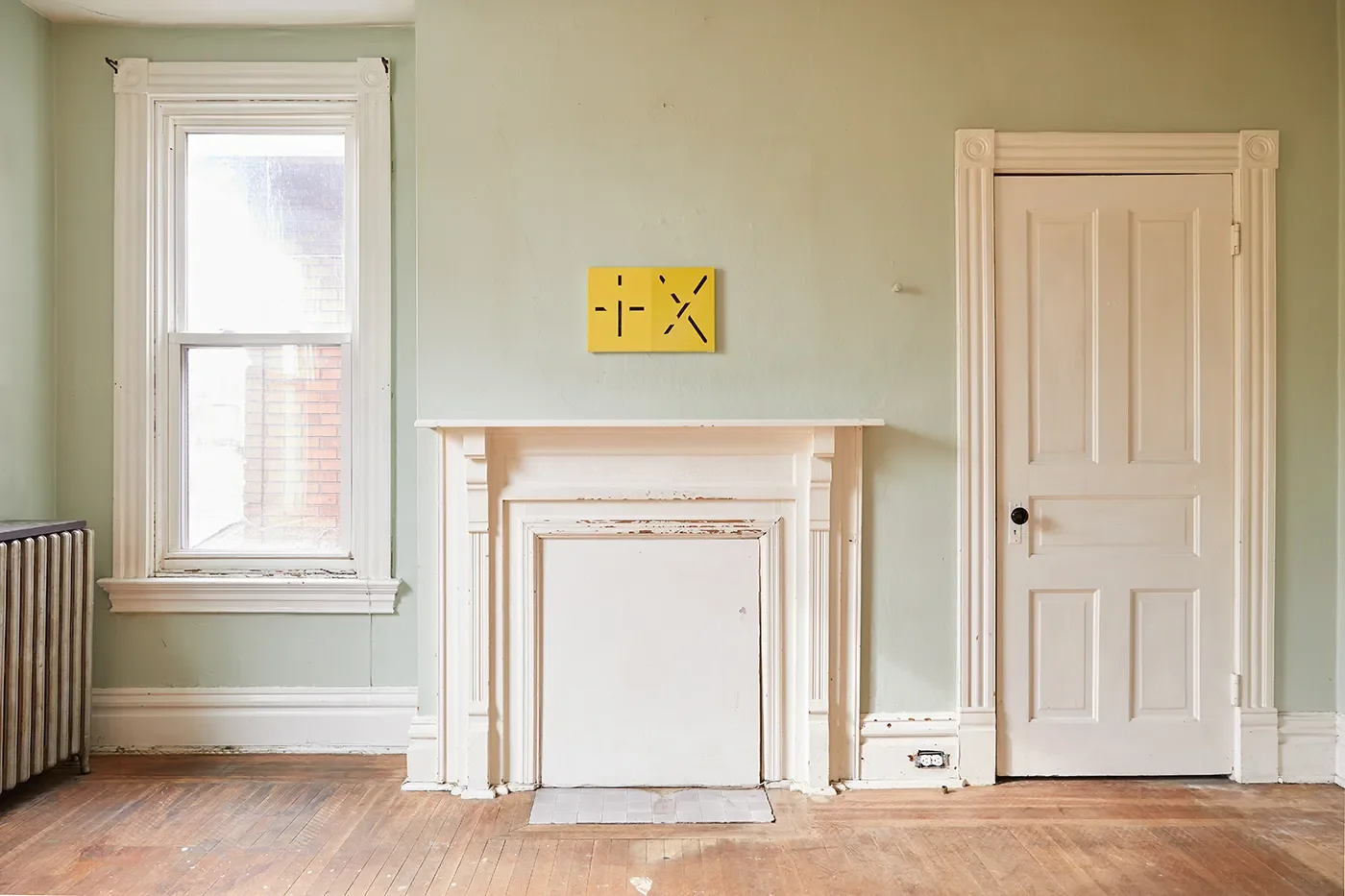
(John): [When Joey invited me, I] visited the space, getting to know the light and thinking about the ideas and forms that would help me make the work. Right away, I knew I wanted to build the work around We by Yevgeny Zamyatin, whose language informs most of the titles in the show.
In that book, a future totalitarian state in a glass city is shaken by revolution. Within the city is the “Ancient House,” an old Victorian building turned museum intended to remind citizens of the excesses of their (now historical) humanity. It serves as a revolutionary headquarters.
Most of the work in the show pulls on compositional elements I’ve been using for a while. Generally, they consist of a solution line pulled from a maze (like one on the back of a cereal box) that is then combined with a quartering of the composition either vertical/horizontal (+) or diagonally (X). When combined, these two ordered elements – the solution and the organization – do not add up to create more order. Yet neither do they create chaos.
How this relates to my life is harder to explain. It has become a model for thinking about the world (well, maybe more like cultivating a feel for the world). It helps me not search exhaustively to render everything around me comprehensible but rather to find things indistinct and interconnected.
(Joey): I came to Wilkinsburg because of Haylee. We were roommates in grad school where we were in the same program. I had a desire to create my own, sustainable, version of the artistic communities I was nurtured by in SLC [Salt Lake City].
How could I have a studio? How could I create a space that I could share with other artists as well? Somehow tending to a rundown house became my way to think through things.
My “practice” feels like a meandering and shapeshifting river, one that frequently jumps its banks ~ flooding some areas, then narrowing to carve deeply into others. When I use the word practice, I refer to my art practice but also to my life practice.
Much of how I frame my way of living, making, and being in the world is as push[ing] back on the messages I’ve received from the culture I’ve been shaped in – an attempt to find and even expand the edges of the ways of living I have been given. I work against the voices (including my own) that say “art is an object”, “art is what one finds in art institutions, museums, and galleries,” but also the voices that say, “as a woman, I should be more interested in decorating a home” than physically building – or demolishing – one.
It’s hard to live in a place that has so much blight without immediately wanting to remake it. I’d been given a particular mythology about Wilkinsburg: big houses that needed work but could be bought for a few thousand dollars, fixed up with a lot of elbow grease and a willingness to rough it.
I was drawn to the seemingly abandoned and derelict building next door at 839 Holland Ave. The house was in bad shape, with a three story balcony that was rather dramatically collapsed. Folks on the block talked about what a shame it was, how it had been empty for a long time, and all reported that it was high on a fabled demo[lition] list. The house was a clear danger to anyone living nearby.
I found [that] I increasingly felt protective of the lot next door. It was being used as a dump. I could relate to the abandoned garage in the back alley overrun with plants and filled with debris and garbage. I decided to do something with it.
The garage project was my first effort to work with the land next door. The slow pace and visibility of [clearing out the garage] meant folks saw me at it regularly. That provided opportunities to talk with neighbors and passersby and clearly signaled how the lot was now cared for. What I was doing eventually evolved into the idea of transforming the garage into a lightbox.
The process of working with the garage began early on in my relationship with Tony. He spent several Saturdays helping me clean it out and then, as the project evolved, installing the structure for the garage’s transformation. I’m pretty sure this was where he fell in love with me. THE GRID
(John): I think so many of the houses falling apart here are the result of absent landlords collecting rent on homes without ever reinvesting in their physical structure or maintenance. These absentee landlords siphon out profit from a resource (shelter) used to depletion via rent collected from people in precarious circumstances.
Working on these houses as Haylee & I have [John and Haylee have renovated two houses –jbk], I’ve come to realize that so many homeowners make repairs in circumstances of urgency while lacking resources. The most affordable fix is a patch, and so many of these homes are patch upon patch – haunted by the less than fantastical, all too mundane ghosts of extraction and austerity.
(Joey): Tony & I had started a free artist-in-residence project in our home. It offered artists time and logistical/intellectual support by providing room, board, and studio space. However, locating the residency project within our home alongside our large and exuberant canine housemate impacted who the residency worked for!
While I was attracted to the idea of residencies as an opportunity to encounter other ways of thinking and making, I couldn’t afford to travel around and participate in them. If I couldn’t go out into the world as much as I wanted, perhaps I could invite the world to me.
Although technically vacant when put up for sale by owner, 843 Holland [Ave.] had recently been inhabited by the owner’s family. Like many of the buildings in the region, a lot of maintenance had been deferred. It needed a lot of work. But when 843 came up for sale, the immediate thought was to relocate the residency there.
We bought the building in July-August of 2019, and while we bought it with the intention of creating a space for the residency, we also wanted to provide a decent place for folks to live that wasn’t solely focused on extracting rent/making a profit.
843 Holland – Blank Space (the LLC that owns the building and that Tony and I formed) – is where John’s show took place.
“INDISTINCT & INTERCONNECTED”
(John): The renovation of our current home has been different from either of Joey’s projects. The place had been stripped down to framework and siding, little left from the original interior that wasn’t just dust or lath.
The evidence of history has been slim, limited to shards of things dug up in the lawn or penciled measurements on the studs from when they built the place in 1910. The tiling on the downstairs fireplace has two tiles depicting a white man and woman (well, it’s green tile) in what I guess is Victorian dress. Tonge (our downstairs tenet) and I have dubbed them the “colonizers” and I’ve been meaning to remove them.
The process of renovating houses meant we were out on the sidewalk, porch or driveway where everyone is walking, driving by or saying hello, asking what we are up to and commenting on our progress. Small, repeated interactions lead up to names, where people live nearby, and how long they’ve been here. Nice and easy and small community stuff.
Despite the pandemic, we’ve sustained some of that, bracketed by safety guidelines. Right now, there’s the small, remote stuff we can do for each other. Normally, it’d be stopping and chatting with one another when you might happen by, impromptu backyard get togethers, trading veg[etable] growing tips, produce, local news and gossip. It’d be community emails threads (informative, confusing, repetitive) and group texts.
We’ve received so much help: a handy neighbor fixed up our busted bumper, a passerby helped move a stove into the house. [There were] tools freely lent and food readily gifted.
We’ve tried to put back that care: car rides for friends and neighbors who need to get somewhere, pharmacy pick-ups, reading over an eviction threat letter, helping out with yard work and making and delivering more food. It happens in an unplanned way, and sometimes it feels like a rising chorus.
But there is still such disconnection [that] you can chart along age, race, income, housing, location.
(Joey): A lot of what I’ve been doing – cleaning out 843, spending time with the ghost of 839 (the house that I tried to gentle the demolition of), and now being present with the land – is a form of tending.
As I’ve been working with these buildings, I’m thinking about the ways that I am uncovering, undoing, and redoing other people’s labor. The ways I am adding my own and that of the folks that I’ve hired to work with me.
I feel like I’m getting lost in the weeds a bit, and maybe that’s okay. I’ve connected with all sorts of neighbors. Some have given me bits and pieces of these houses’ histories along with stories of the rest of the neighborhood. Others have lent me tools, given advice, and even provided labor. I’ve been learning about lead paint and plaster, drainage, roofing; various construction materials, tools, and techniques. I’ve loved puzzling out what was done, problem solving involving forms of historical excavation and mapping.
The work has generated an abundance of questions. I’ve spent little time in the studio the past few years but have (literally!) gathered materials, knowing that these will, at some point, make it into art objects: door knobs from 839, lath, nails and other fasteners, keys, lists of the “weeds” growing around 839, sections of the ivy that had formed a roof over the garage, photo-documentation of the structures …
Tending these three lots has provided so much! I’ve honored my instincts about how to work with the lots and structures in respectful and meaningful ways.
(John [from an old interview]): “The first time my friends and I stayed in Wilkinsburg, we had a little campfire going, and throughout the afternoon 10-15 people from around the neighborhood stopped by and we got a chance to meet them. It was a really big welcome and I think that was the instance that solidified our decision to move here. …
“[I]t would be near impossible to build a community like the one we have here[,] and we don’t want to give it up. That’s really what’s kept us here in Wilkinsburg permanently. In all of the places I’ve lived, I’ve never known and appreciated my neighbors as much as I do here. When we sit on our porch, [many a] person that walks by is someone we know.” (source)
It’s not always a party around here, but there’s still some glue.